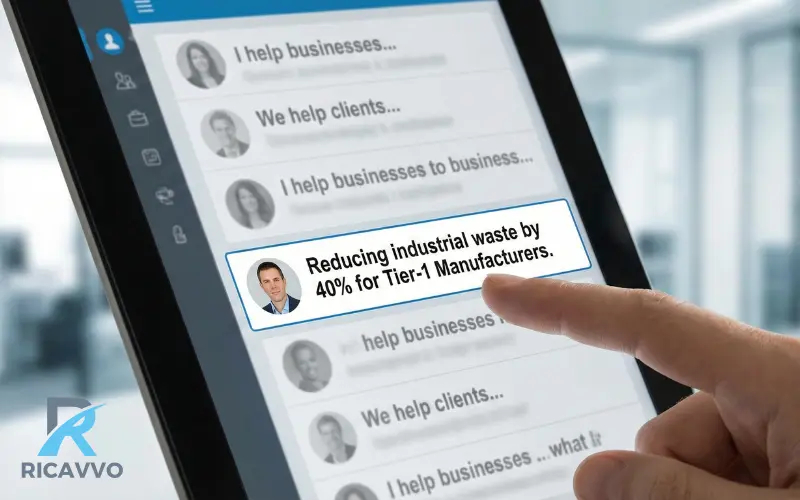
Open your LinkedIn connection requests right now. Or worse, check the cold emails sitting in your inbox.
If your feed looks anything like mine, you will see a sea of sameness. It is a constant stream of the exact same sentence structure repeated by professional service providers across every industry:
"We help [Target Audience] do [Action] so they can [Result]."
"I help B2B owners scale..."
"We help startups optimize..."
"I help marketing teams align..."
I call this the "We Help" Dilemma.
Ten years ago, this formula was the gold standard. It replaced vague job titles with clarity. But in today's market, this formula has become background noise.
The Psychology of "Clicking On By"
As a CEO, I am the target for hundreds of these pitches every week. Here is what happens in the brain of a buyer when they see that formula.
- 1Pattern RecognitionFirst, my brain recognizes the sentence structure instantly.
- 2CategorizationSecond, it instantly categorizes the sender as a solicitor rather than a peer.
- 3FiltrationThird, to conserve mental energy, I ignore it.
It is called Banner Blindness. Just as internet users learned to ignore banner ads in the 90s, decision-makers have learned to ignore sentences that start with "I help."
The Status Issue
The deeper issue with "We Help" is one of status.
When you open a conversation by saying you want to "help" me, you are unintentionally placing yourself in a subservient role. It feels like a junior employee offering assistance rather than a master of their craft offering a transformation.
"True experts do not plead to help. They state their truth."
The Antidote: Meaning and Specificity
If you want to stop the scroll on LinkedIn or get your email read, you have to break the pattern. You need to move from promising assistance to claiming authority.
Here are three ways to fix the "We Help" Dilemma.
1. The "Why" Approach (The Mission)
Instead of telling me what you do, tell me what you believe. This creates immediate alignment on values.
2. The Outcome-First Approach
Stop focusing on your act of helping. Focus entirely on the result you deliver.
3. The Methodology (The Provocation)
Highlight how you do it, especially if your method is unique.
The Bottom Line
The market is noisy. "Helping" is safe, polite, and terribly boring.
If you are in the professional services business, stop blending in. Stop using the templates the gurus taught you in 2015.
Don't just tell me you can help. Tell me why you do what you do. Tell me what you stand for. That is how you start a real conversation.